Convert working time in both directions. Instantly, clearly, and without a spreadsheet.
ResultExact
7.75
Decimal hours
Equivalent duration: 7 hours 45 minutes
How it is calculated
7 + 45 ÷ 60 = 7.75
01 / Calculation
One hour. Two ways to write it.
45 of 60 minutes covers the same part of an hour as 75 of 100 hundredths. The duration stays the same — only its notation changes.
How it is calculatedHours + minutes ÷ 607 + 45 ÷ 60 = 7.75
45Minutes
=
0.75Decimal hours
02 / Conversion table
Conversion table
Find a minute value at a glance. Every value is a fraction of one hour; the table uses two decimal places.
0 Minutes
0.00Decimal hours
5 Minutes
0.08Decimal hours
10 Minutes
0.17Decimal hours
15 Minutes
0.25Decimal hours
20 Minutes
0.33Decimal hours
30 Minutes
0.50Decimal hours
45 Minutes
0.75Decimal hours
60 Minutes
1.00Decimal hours
Show all 0–60 minutes+
Minutes to decimal hours · rounded to 2 decimal places (0–20)
Minutes
Decimal hours
0
0.00
1
0.02
2
0.03
3
0.05
4
0.07
5
0.08
6
0.10
7
0.12
8
0.13
9
0.15
10
0.17
11
0.18
12
0.20
13
0.22
14
0.23
15
0.25
16
0.27
17
0.28
18
0.30
19
0.32
20
0.33
Minutes to decimal hours · rounded to 2 decimal places (21–40)
Minutes
Decimal hours
21
0.35
22
0.37
23
0.38
24
0.40
25
0.42
26
0.43
27
0.45
28
0.47
29
0.48
30
0.50
31
0.52
32
0.53
33
0.55
34
0.57
35
0.58
36
0.60
37
0.62
38
0.63
39
0.65
40
0.67
Minutes to decimal hours · rounded to 2 decimal places (41–60)
Minutes
Decimal hours
41
0.68
42
0.70
43
0.72
44
0.73
45
0.75
46
0.77
47
0.78
48
0.80
49
0.82
50
0.83
51
0.85
52
0.87
53
0.88
54
0.90
55
0.92
56
0.93
57
0.95
58
0.97
59
0.98
60
1.00
Day 17:45
Day 28:15
Total16:00
↔
Decimal hours
7.75 + 8.25
16.00
03 / Hours
Less mental arithmetic. More clarity.
Decimal hours make it easier to add working time and multiply a duration by an hourly rate. For example, 7.75 hours × 20 = 155. Keep full precision while calculating and round the final result only when needed.
04 / The story of time
The story of time
Why do our clocks count in sixties, while our calculations use tenths and hundredths? Two different traditions meet in one everyday number.
An illustration of timekeeping: sunlight, a sundial and a 60-part circle.
60
Why 60 minutes?
Our time system grew over centuries. Ancient Egyptian day divisions were one part of the story; Babylonian astronomers used base-60 calculations. The number 60 divides evenly by 2, 3, 4, 5, 6 and 10, making fractions particularly convenient. The first and second fractional places in that tradition are behind today's minutes and seconds.
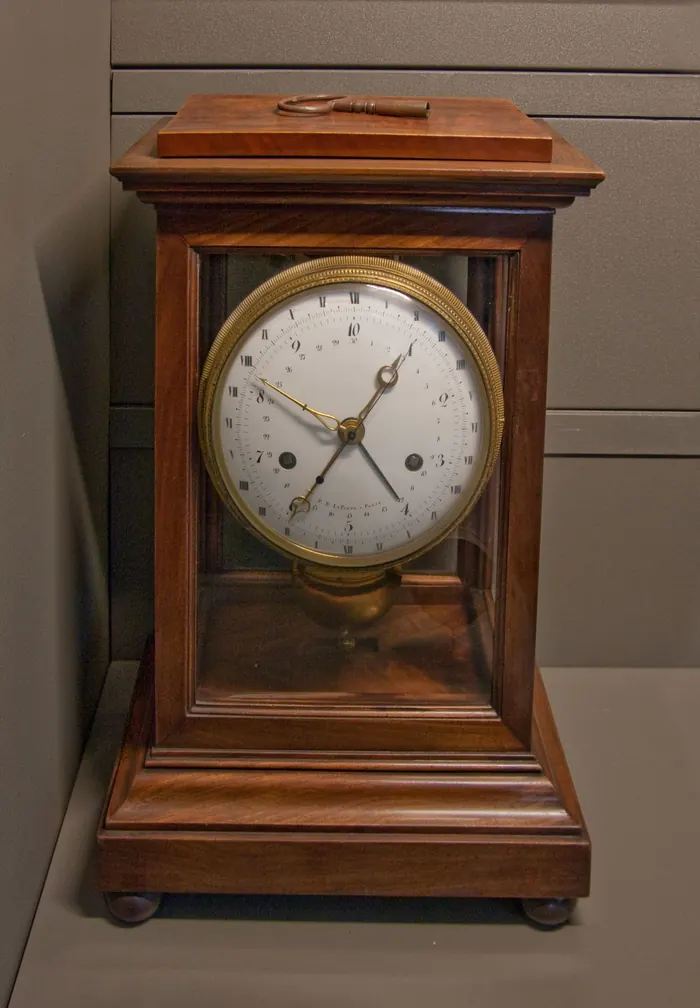
During the French Revolution, decimal time divided a day into 10 hours, each hour into 100 minutes and each minute into 100 seconds. The system did not become a lasting everyday standard. This clock made by Pierre Basile Lepaute in 1795 shows decimal and conventional scales together.
That is not what this calculator does: here, an hour always remains 60 ordinary minutes. We only write it as a decimal number.
Divide the minutes by 60. For a duration with whole hours, add those hours: 7 + 45 ÷ 60 = 7.75.
Is 0.50 hours the same as 50 minutes?+
No. 0.50 × 60 = 30 minutes. Decimal digits describe a fraction of an hour, not a minute count.
Why does one minute show as 0.02 hours?+
1 ÷ 60 = 0.016666… hours. At two decimal places this rounds to 0.02. Choose more decimal places when you need a closer approximation.
Can I enter 90 minutes or a full working week?+
Yes. 90 minutes gives 1.50 hours, and 38 hours 45 minutes gives 38.75 hours. This is a duration calculator, not a 24-hour clock.
Should I round each entry before adding it?+
To avoid accumulated rounding differences, add the original durations first and round the total afterwards. Your employer's billing rules are a separate matter.
What is the difference between decimal hours and hundredths of an hour?+
Decimal hours express a duration as a decimal number of hours, for example 0.75 h. One hundredth of an hour is 0.01 h = 36 seconds. So 75 hundredths equal 0.75 h, which is 45 ordinary minutes.
MEGASHIFT
Your working time. Already worked out.
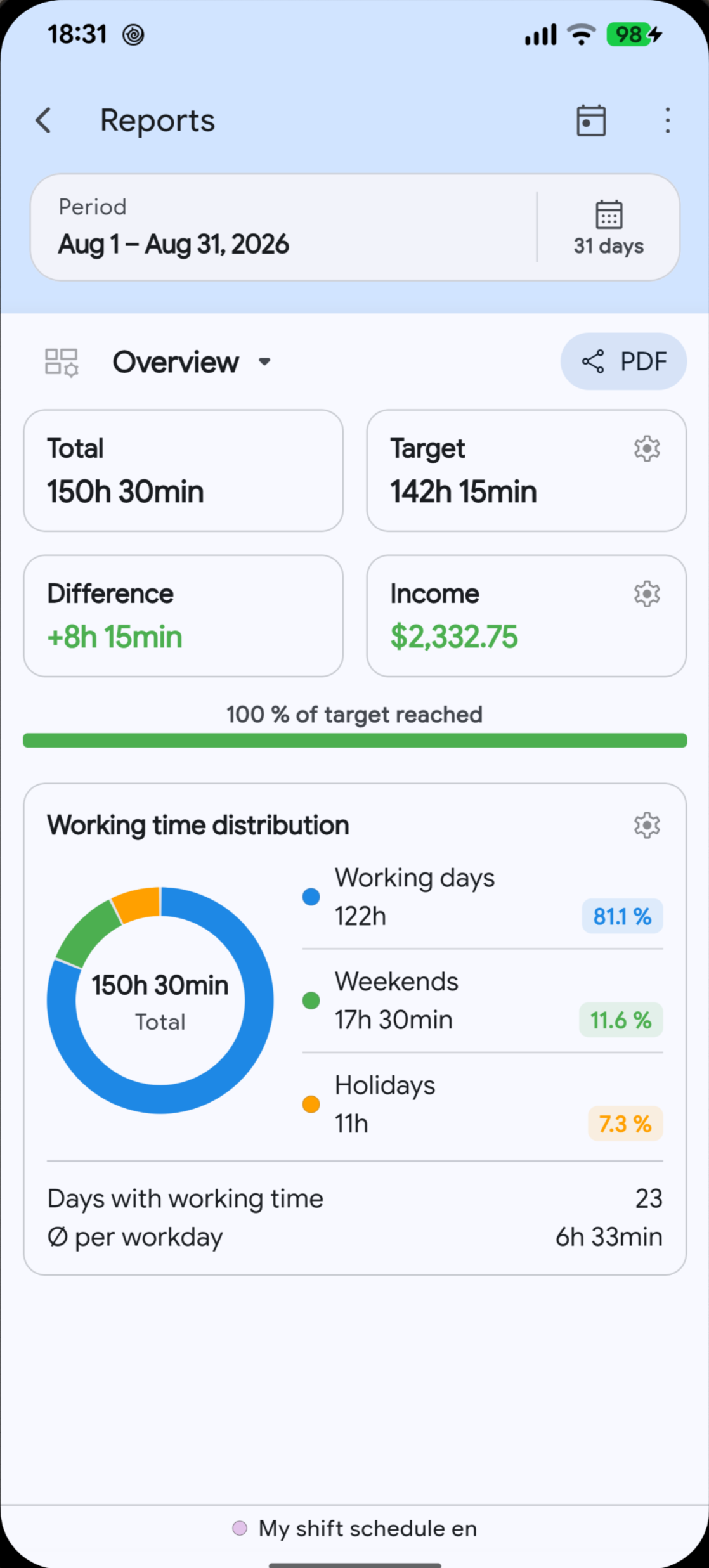
Regularly calculating your shifts? Megashift helps you plan your schedule, calculate working hours automatically and see your reports in one place.